









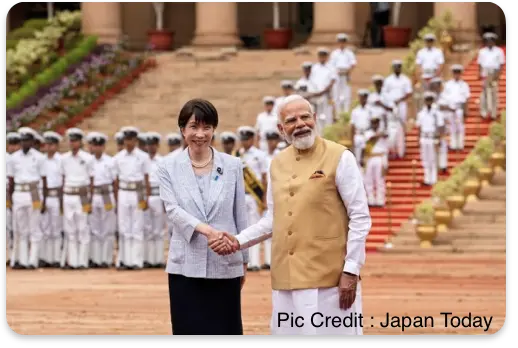
The current visit of Japanese Prime Minister, Sanae Takaichi to India can lead to strengthening of bonds between India and Japan in ways which are unprecedented. On cards is collaboration in areas related to trade, investment, defence etc. The visit is on the invitation of Indian Prime Minister, Narendra Modi and scheduled from 1 to 3rd of July. Considered by many, as a hugely important move, significant developments are expected. “The Summit will provide an opportunity for both sides to review and strengthen the full spectrum of bilateral cooperation as well as exchange views on regional and global issues of mutual interest,” MEA has said. The long-awaited shift in looking eastwards may have come at the nick of time for India. But some experts are of the opinion that it may be too little too late. Some go the extent of stating that wooing for a marriage of convenience has the threat of a cliff fall before honeymoon! India has been for long been in a sort of one-sided courtship with the West. Time and time again, US & European Nations have not come to the recue of India. Be it Energy Security, Environment Issues, COVID Shield, Terrorism, Immigration, Armaments et al. India has learnt the hard way that at a crucial juncture, West may take a complete volte face. With hostile neighbours, India is often on the razors edge. Hence much is expected from the Japanese PM’s Visit.
Japan is one of the most Technologically Advanced nations in the world with a reputation of unparalleled industriousness and ancient cultural values. Indians always had a positive experience whenever it collaborated with Japan. Readers will recall Mitsubishi, Hitachi, and Toshiba supplied electric locomotives to Indian Railways in 1960s, the game changing collaboration between Maruti and Japanese Automaker Suzuki Motor of 1982, HMT Watches had started by using Citizen Calibre 0201 movements (Japanese) in 1961, the 7.5 km Delhi-Noida Direct (DND) Flyway was constructed by a Japanese consortium of Mitsui & Co. and Marubeni Corporation which opened to public on February 7, 200. Currently on the cards is the India-Japan Semiconductor Memorandum of Cooperation, Japan’s Renesas Electronics and India’s CG Power are establishing a ₹7,600 crore semiconductor facility in Sanand, Gujarat, to produce 15 million chips daily. Japan is the largest bilateral donor to India, having extended Overseas Development Assistance (ODA) since 1958. The upcoming Mumbai-Ahmedabad High-Speed Rail (utilizing Shinkansen technology) and ongoing support for the Delhi Metro are currently on. Japan is also financing nine major regional projects across India, including a ₹12,800 crore development package featuring a medical college hospital in Nagaland. Both the nations participate in the Quad alliance alongside the US and Australia. They have an active Acquisition and Cross-Servicing Agreement (ACSA) for logistical support, combined military exercises, and regular “2+2” Foreign and Defence Ministerial meetings are held to ensure maritime security in the Indo-Pacific. Japanese conglomerates are heavily invested in the Indian market, with over 1,400 active Japanese corporations operating across 11 officially recognized Japan Industrial Townships (JITs).
The Japanese Prime Minister Sanae Takaichi and her Indian counterpart Narendra Modi are set to agree on Thursday boosting collaboration in semiconductor and critical mineral supply chains, among other economic security fields. The two leaders are also likely to affirm bilateral cooperation in stable energy procurement, as well as maritime security and defence equipment, as the outbreak of the U.S.-Israeli war with Iran in February disrupted global oil supplies, Japanese government officials said. Takaichi and Modi will hold a joint press event after the talks, with multiple outcome documents set to be released, according to the officials. Japan regards India as a key partner to advance a “free and open” Indo-Pacific, where China has been assertively increasingly its military and economic influence. The summit also comes amid strained Sino-Japanese ties. Since January, China has tightened controls on Japan-bound shipments of dual-use items usable for civilian and military purposes, apparently including essential rare earths. Takaichi is on her first visit to India since taking office last October. She will wrap up her three-day trip on Friday.
Many experts feel that India must make the best use of the ensuing opportunity. Looking East is the most cogent thinking which India can have at the moment. West has its own concerns. It is deeply mired in dealing with issues of their own making and has scant time for other nations. And the mercurial policy changes have to be lived with by other nations. Now, the Indian Bureaucrats must be part of the solutions and come up with a comprehensive package which augurs the best for India. They need to be realistic, at the same time, not be bound by age old beliefs. If need be, they can even seek the assistance of global Indian Diaspora – Industrial, Corporate, Finance, Economic and Policy leaders. There is no shame in it. Professionals who know the game and willing to assist Team India should be roped in, apart from Indian Thinktanks and Planning bodies. Mind you the government and the Leader of India, Narendra Modi has made a window of opportunity available so let’s meet their expectations.