
















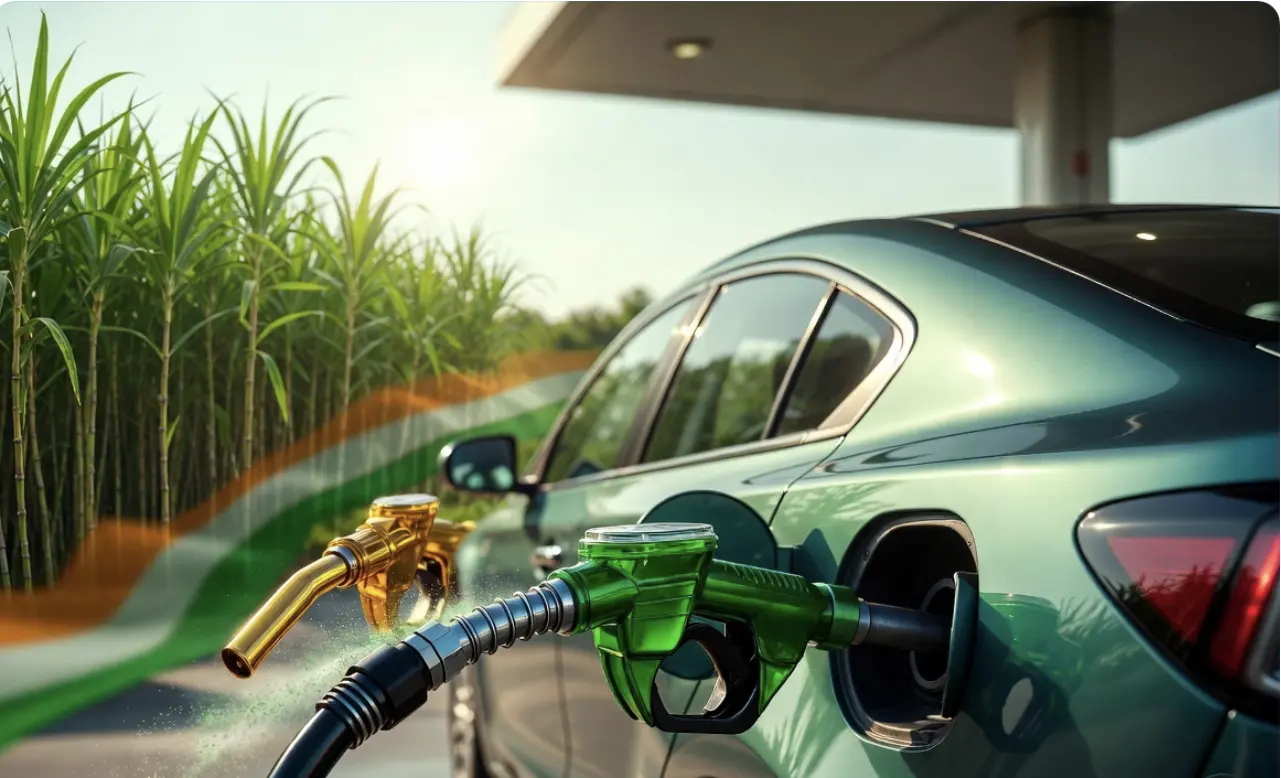
The E 20 ((a blend of 20% ethanol and 80% petrol) debate is raging in India and everyone seems to have a viewpoint. There is a serious divide amongst some car owners and suppliers. The Government is trying its best to justify use of Biofuels in blending with Petrol for use as automotive fuel. This has made some of the Car Owners, Drivers unhappy who claim that it spoils the engine. India has the world’s largest Two-Wheeler market and the third-largest Car market. Due to the increasing cost of Crude, much of which India imports, it has been trying to reduce import oil and also cut carbon emissions. Blending of blending ethanol in petrol was started sometime in the mid-2000s and there has been a steady increase in the percentage. Currently, most Petrol Bunkers are selling a mix of 20% Ethanol in Petrol in place of 10% used earlier. E 85 which has 85% Ethanol blend has also been started on an experimental basis.
The Complaints of Motorists have been that there is a Mileage Drop, a 5% to 10% drop in fuel economy and other Performance Issues. It was in Year 2023 that Vehicles compatible with E20 started getting manufactured. Remember the Euro 5 Euro 6 Compliant fuels and the Catching up which the Automobile Sector had to do? The earlier engines are not really compatible with E20. Drivers complain of Slow Acceleration and a rougher ride. It’s also being said that there is Engine and Fuel System Damage, Ethanol can corrode certain metals like aluminium and brass and degrade rubber hoses, seals, and plastic fuel tanks. There are also claims that there are Fuel System Deposits over time, ethanol-blended fuel can lead to Injector deposits, Moisture buildup and Corrosion risk. Also, there is a lack of Cheaper Alternatives, unblended or low-ethanol petrol can be up to 40-50% more expensive. Further there are a smaller number of Bunkers selling Pure Petrol.
On the other hand, Govt of India has stated that E20 petrol is a safe and a scientifically validated fuel while admitting there is a minor 3% to 5% drop in fuel economy. The Ministry of Petroleum and Natural Gas confirmed that E20 underwent over 40,000 km of rigorous testing before its rollout. Automakers like Maruti Suzuki serviced nearly 1.5 crore older vehicles originally certified only for E10 without detecting E20-linked corrosion or abnormal wear. It has higher octane rating, better engine pickup, and smoother acceleration. The older engines function safely without damage. Union Minister Nitin Gadkari additionally noted that automakers have been instructed to replace metal washers in older vehicles with E20 compliant rubber ones at no extra charge during routine servicing. Additionally, officials and insurance companies have clarified that using spec-compliant E20 fuel will not void vehicle warranties or invalidate insurance claims. The Petroleum Ministry clarified that producing E20 is actually costlier than pure petrol at prevailing global crude oil prices i.e $70/barrel. Despite this, the program was brought in to insulate consumers from volatile international oil price spikes, reduce crude imports, and boost farmers’ incomes. The social media has been active in denouncing E20 but gradually the consumers are taking heed of the scientific data available on its use.
Oil & Gas experts however share a few points which are maybe not so prevalent in the current discussions. They point out that the efforts for blending Ethanol with Petrol is not new. The ethanol blending movement in India began with pilot projects and testing in 2001. Following this trial, the government formally launched the Ethanol Blended Petrol (EBP) Programme in January 2003. PSU Companies started floating tenders for Ethanol as early as 2006 however there was a poor response. Most of the Ethanol obtained primarily from Sugar Cane Molasses were cornered by Liquor Distilleries. In 2009, OMCs floated tenders for roughly 680 million litres but domestic sugar mills and suppliers bid for and supplied only about 40% of the required volume. There was a breakdown in procurement in 2013-14, OMCs had sought a total of 1.56 billion litres of ethanol for the supply year. Domestic mills offered only 620 million litres, and OMCs finally accepted to lift 350 million litres at Rs 47.5 per litre. However, as global crude oil prices crashed from around $114 to $72 a barrel, OMCs cancelled the procurement tenders in late 2014, attempting to force sugar mills to cut prices to Rs37–Rs38 per litre. This led to immense supply disruptions and the blending percentage falling to as low as 1.33%. It’s a fact that Sugar Cane requires lots of water for cultivation leading to fall in groundwater levels. Although Maize which takes much less water for cultivation has recently overtaken sugarcane as India’s primary ethanol feedstock. Maize-derived ethanol currently accounts for 48% to 51% of the country’s total ethanol production, while sugarcane-based ethanol (including sugarcane juice, B-heavy, and C-heavy molasses) has dropped to approximately 31% to 35%. Now in year 2026 there seems to be no problems in sourcing Ethanol. Experts opine that the wait was for the domestic players to catch up and then E 20 to E85 has been unleashed on the consumers. This fact is noted by experts and there has been much discussion and speculation in the media on the two prominent Ethanol players in the market today. Experts also mention that the Crude Price had fallen sharply after the US – Iran truce and it would be imprudent not to procure and stock crude at those prices. Obviously, the Ethanol prices would continue to be what they are (it’s hardly probable that 2013-14 story will be repeated) then the consumer will have to pay ‘extra’ despite lowered Crude Prices. The argument that Oil & Gas Product prices are based overall on the Crude Prices will not hold good. They also observe that a total commitment and shift from food crops to Ethanol producing crops may impact food prices in India. On the pollution front as well there is no clear-cut word whether CO2 or NO2 emissions are more harmful. And then there is the case of EVs. It should not happen that those investing on Ethanol may face a not so rosy picture in future and approach the Government for subsidies!
The debate may continue for a while though there are huge Macroeconomic and Environmental benefits of Ethanol blending, Auto Manufacturers, Engine Troubles, the mileage conscious Indian Driver may call the last shot. It may remain contentious before we see who reaps the crop.