





India’s Ethanol Revolution: Minister Puri’s Vision for Sustainable Biofuels
Synopsis

New Delhi: Shri Hardeep Singh Puri, Minister of Petroleum and Natural Gas, spoke passionately about India’s unstoppable ethanol journey during a Fireside Chat Session at the Pioneer Biofuels 360 Summit. He highlighted the remarkable success of the Ethanol Blended Petrol (EBP) program, attributing its significant progress to the policy reforms initiated after 2014 under Prime Minister Narendra Modi’s leadership.
The Minister proudly shared that India surpassed its ethanol blending targets ahead of schedule, achieving 10% blending by 2022 and advancing the original target of 20% blending to 2025. He credited this success to sustained policy reforms, such as guaranteed pricing for ethanol and the expansion of distillation capacity nationwide. Shri Puri also debunked myths surrounding ethanol-blended fuel, emphasizing that it has not caused any engine failures or breakdowns, drawing parallels with Brazil’s successful adoption of E27.
Despite facing opposition from vested interests, the Minister remained confident in India’s ethanol revolution, stating that the transition to E20 is irreversible due to strong policy support, industry readiness, and public acceptance. He elaborated on the benefits of E20, including reduced greenhouse gas emissions, improved air quality, enhanced engine performance, and substantial foreign exchange savings.
Shri Puri highlighted the conversion of agricultural residues into ethanol at 2G ethanol refineries, showcasing a sustainable solution for clean fuel, pollution control, and increased farmer income. He also commended the growth of maize-based ethanol, marking a significant shift in fuel production.
Addressing Flex-Fuel Vehicles (FFVs), the Minister praised the Indian automobile industry for developing prototypes of E85-compatible vehicles and emphasized the gradual transition towards higher ethanol blends. He outlined the Ethanol Blending Roadmap (2020–25) and emphasized the importance of industry readiness and consumer acceptance in achieving the targets.
Emphasizing the transformative impact of ethanol blending, Shri Puri highlighted the benefits to farmers, reduced crude imports, foreign exchange savings, job creation, and climate commitments. He underscored the significant contribution of ethanol procurement in empowering farmers and reducing crude imports, showcasing the positive impact of the program.
Regarding Sustainable Aviation Fuel (SAF), the Minister outlined India’s collaborative efforts with various stakeholders to develop and scale up SAF. He detailed the phased approach to SAF adoption, with blending mandates set for international flights, demonstrating India’s commitment to innovative and sustainable practices in the aviation sector.
You May Also Like
India’s Energy Sector Gears Up for Growth at Urja Varta 2025: Insights from Hardeep Singh Puri
Jul 17, 2025
The Inter-Ministerial Round Table held on the sidelines of Urja Varta 2025 showcased the collaborative spirit of cooperative federalism championed under PM Modi’s leadership. Ministers and officials from 22 States and Union Territories came together to explore energy sector opportunities across regions. In his address at the Round Table, Union Minister of Petroleum and Natural […]
India Sees 143% Surge in FDI Over Past Decade: Petroleum Minister Hardeep Singh Puri
Jul 1, 2025
New Delhi, July 1 — India has witnessed a remarkable 143% increase in foreign direct investment (FDI) over the past 11 financial years, attracting a cumulative total of $748 billion, according to Union Minister for Petroleum and Natural Gas, Hardeep Singh Puri. Speaking at the “Celebrating 77 Years of Trust” event organized by the Institute […]
India to Drive 25% of Global Energy Demand in Next Two Decades – Hardeep Singh Puri
Apr 15, 2025
New Delhi: At the OALP Round-IX and DSF contract signing ceremony organized by Hydrocarbon at Hotel Taj Palace, Union Minister for Petroleum and Natural Gas Hardeep Singh Puri proudly stated that India is providing gas to its consumers at the most affordable rates globally. Addressing media queries, he highlighted the progress in the energy sector […]
Hardeep Singh Puri’s Presence of Mind Averts Major Incident at IEW-25
Feb 13, 2025
New Delhi, IEW-25:Union Minister Hardeep Singh Puri’s presence of mind averted a major mishap during India Energy Week (IEW). The incident took place at the ONGC pavilion in IEW-25, where the minister’s visit was scheduled. As soon as the minister arrived at the pavilion, a large crowd suddenly gathered, and the situation began to get […]
India Energy Week: Minister Hardeep Singh Puri Highlights India’s Clean Cooking Fuel Model
Feb 12, 2025
New Delhi, February 12, 2025: On the second day of India Energy Week (IEW-25), Union Minister for Petroleum and Natural Gas Hardeep Singh Puri briefed the media, sharing details of multiple bilateral meetings with ministers from Sudan, Brazil’s Petrobras, Malawi , Nepal, Tanzania, and several African nations. Speaking about a ministerial session on clean cooking […]
Hardeep Singh Puri to Outline Vision for India Energy Week 2025
Feb 7, 2025
New Delhi, February 7, 2025: In the lead-up to India Energy Week 2025, Hardeep Singh Puri, Minister of Petroleum and Natural Gas, will shed light on India’s strategic priorities in the energy sector on February 10, 2025, at 6 Akbar Road, New Delhi. The event is expected to focus on key initiatives aimed at driving […]
Sponsored by Google, a partner of NewsIP Associates.
Sponsors' Logos







Appointments News
BPCL Finance Director V. R. K. Gupta Reportedly Gets Five-Year Tenure Extension
Chacko M. Jose Emerges as Frontrunner for BPCL Director (Refineries)

Chartered Accountant Amol Taori Assumes Finance Leadership at POWERGRID
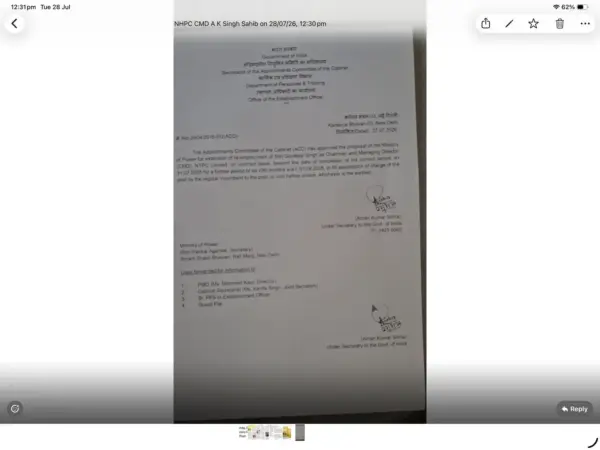
NTPC Leadership Continuity Strengthened: ACC Approves Six-Month Extension for CMD Shri Gurdeep Singh
Shri Vivek Nishant Nath Takes Charge as Director (Commercial) of NMDC Limited – Poised for a New Chapter